Research

Key Takeaways
I
The premise
Institutional real estate is one of the largest asset classes in the world, and the analytical work that deploys its capital is still performed by hand. Approximately $12.8 trillion of assets under management, held across funds, REITs, insurers, pension schemes, and sovereign vehicles, is underwritten, monitored, and reported on through a workflow that would be recognisable to an analyst from 1995: documents are read by people, numbers are extracted by people, models are built cell by cell by people, and the output is checked, when it is checked at all, by other people with the same constraints.
This is not a failure of sophistication. The investors operating this workflow are among the most analytically capable in finance. It is a limitation of the underlying infrastructure. Historically, when an asset class of this size has operated far below what its tools could make possible, the resulting shift has been comprehensive. Capital moved onto spreadsheets in its entirety, then into systems of record. The premise of this note is that a third shift has begun, that most current attempts are failing for identifiable reasons, and that firms which understand those reasons will complete the transition years before firms that do not.
The asset class
Institutional real estate AUM
Funds, REITs, insurers, pensions and sovereign vehicles, globally
The failure rate
AI initiatives that stall
Launched pilots that never reach operational impact
The manual cost
Analyst-hours per screen
Raw listings to underwritten shortlist, conventional pipeline
The new floor
Human decisions required
Across a complete AI-supported screening process, per published research
II
Two operating shifts already happened
The industry has changed its operating layer twice, and the pattern of both shifts is instructive because it predicts the shape of the third.
The first migration moved the work from paper to the spreadsheet. Rent schedules, lease files and valuation workings that had lived in ledgers and filing cabinets became digital, and the time required to construct a discounted cash flow fell from days to hours. The consequence was not merely speed. A small team could evaluate a materially larger opportunity set because the marginal cost of running the arithmetic had fallen close to zero.
The second migration moved the work from spreadsheets into systems of record. Property accounting, lease administration and valuation entered purpose-built platforms with one authoritative rent roll, one closing ledger and controlled model versions. Reliability improved materially, and those platforms remain the industry’s backbone today.
Observe, however, what both migrations optimised and what both left untouched. Each improved storage and calculation. Neither improved analysis. No spreadsheet has ever read a lease. No system of record has ever noticed that clause 4.2 of the second amendment supersedes clause 4.2 of the original, that a side letter quietly neutralises a co-tenancy provision, or that the definition of a recoverable expense differs between two leases in the same building. The extraction of meaning from documents, the reconciliation of conflicting sources, the construction of the model, and the first draft of judgment: every one of those tasks entered the spreadsheet era manual and exited the ERP era manual. For thirty years, the tooling improved at holding information and improved at nothing else.
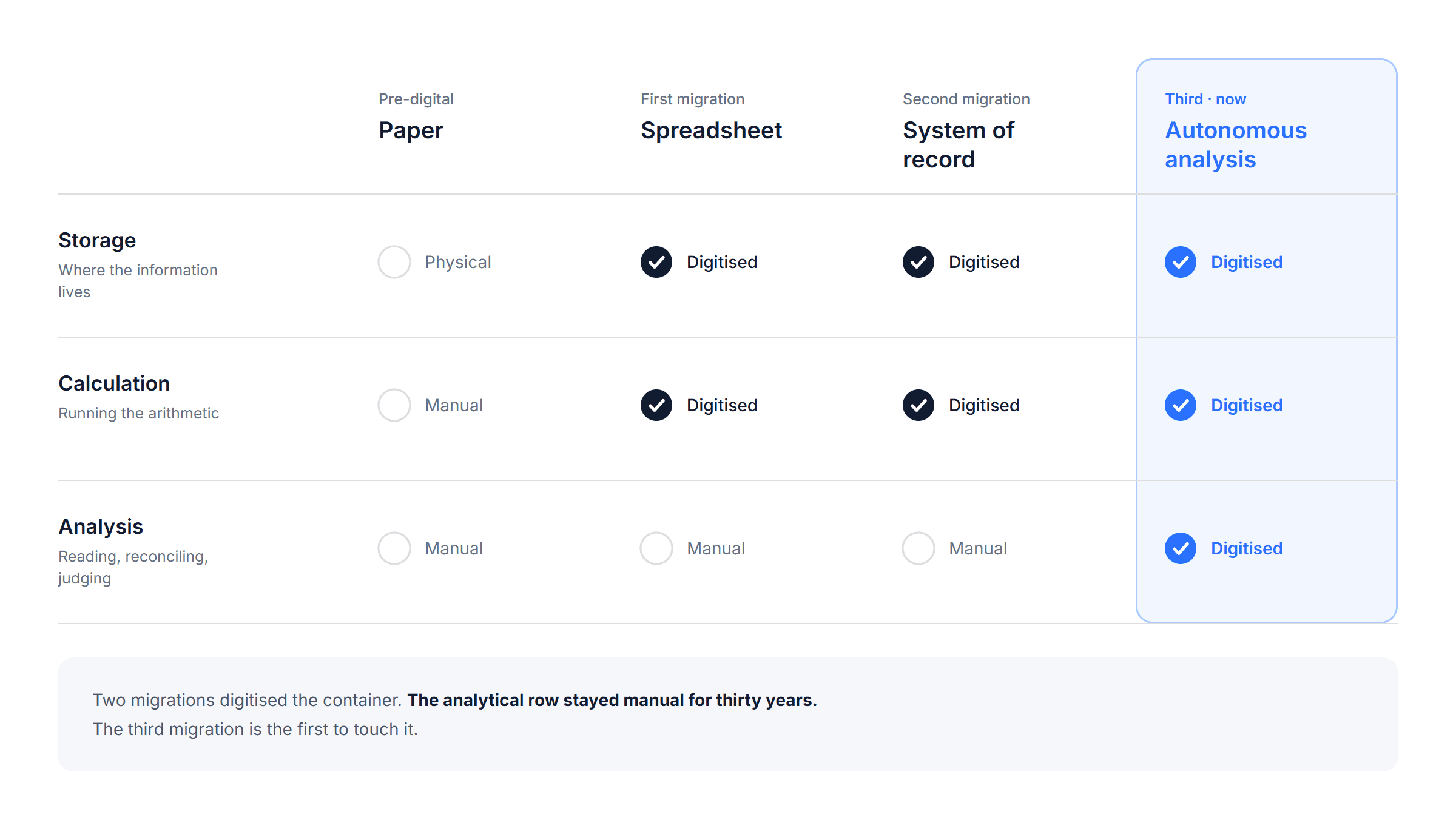
Exhibit 1 — That is why the third shift carries a larger economic footprint than both predecessors combined: it moves the boundary of which tasks require a person at all, rather than accelerating the tasks around them.
III
The anatomy of the pilot failure
The third migration is not failing for lack of enthusiasm. Industry surveys consistently show that most commercial real estate firms have initiated AI programmes, while only a small fraction, roughly one in twenty, report meaningful operational impact. The gap between those figures is the defining fact of the current moment, and it calls for an operational explanation rather than a cultural one.
The explanation is straightforward. Most deployments place a conversational interface over an existing data store, but do not add the controls expected of an institutional investment process. Three weaknesses recur.
The quality of the underlying AI model is not the deciding factor. Even the most capable model will fail in production if its figures are not traceable, its calculations are not repeatable and its work is not independently reviewed. The controls around the model matter as much as the model itself.
Weakness 1
No source trail
Every figure should lead back to the document, page and clause from which it came. An untraceable number cannot support an investment decision.
Fails at
review
Weakness 2
No repeatable calculation
The same inputs must produce the same answer. If a return changes without an assumption changing, the model cannot be relied upon.
Fails at
reconciliation
Weakness 3
No independent review
A model can calculate correctly and still use the wrong assumption, fee base or underwriting treatment. Correct arithmetic is only the first test.
Fails at
the investment committee
Exhibit 2 — None of the three is a model-quality problem. Each is a missing control, which is why a more capable model does not resolve any of them.
The pilots are not failing because AI cannot do the work. They are failing because AI has been asked to do the work without the controls institutional capital would require of any analyst.
Smart Bricks Research
IV
What a production-grade system requires
A production system must do more than produce a plausible answer. It must show where the information came from, calculate consistently, preserve the integrity of the underwriting model and subject the result to independent review. These requirements provide a practical checklist for any allocator assessing an AI-enabled investment process.
Separate document reading from calculation
A reliable system draws a clear line between interpretation and arithmetic. AI is well suited to reading a lease, resolving amendment priority and extracting the definition of recoverable expenses. Cash flow projections, debt amortisation, waterfalls and covenant tests belong in a calculation engine where identical inputs always produce identical outputs. The AI reads; the financial engine calculates. Neither is asked to do the other’s job.
Keep construction and review independent
The system that builds an analysis should not be the system that approves it. In published research, one engine builds the financial model and a separate review engine tests it against 99 underwriting checks across 12 categories. Critical issues, such as an IRR formula pointing to the wrong cash flow or debt that does not roll forward correctly, carry more weight than presentation issues. Each failed check identifies the affected area, the expected result, the result found and the likely financial impact. A correction engine then returns a specific instruction to the model builder. The cycle repeats until the model clears the review standard.
The quality of the reviewer matters as much as the quality of the builder. In the published work, two reviewers assigned materially different scores to the same model because one caught structural issues that the other missed. Production systems can therefore use a second review where the first result is uncertain and escalate disagreements to a person. A high score alone is not enough: a model can work for one asset yet fail when cash flow patterns change. Reliability means that both the calculations and the review standard hold across different assets.
Preserve the integrity of the model
Institutional models are interconnected. Sensitivities, waterfalls, debt schedules and promote structures depend on calculations elsewhere in the file. Rebuilding a template piece by piece can leave the visible outputs intact while breaking supporting calculations. The published research documents one case in which debt service worked but return metrics returned blanks because 25 supporting cells had been omitted. The safer approach is to preserve the approved model in full and populate it without reconstructing its internal logic. The more complex the asset model, the more important it is to preserve the model as a complete system.
Keep judgment with people
Production systems do not remove the investment professional. They concentrate that person’s attention on the decisions that require judgment. In the published screening case, people made three decisions: approving the proposed assumption set, correcting a failed model-population approach and directing an unlevered re-run to separate asset quality from capital structure. The system handled data validation, ranking, model population and return calculation. The useful question is therefore not whether a person is “in the loop,” but which decisions remain with people, when they occur and what evidence is available at that point.
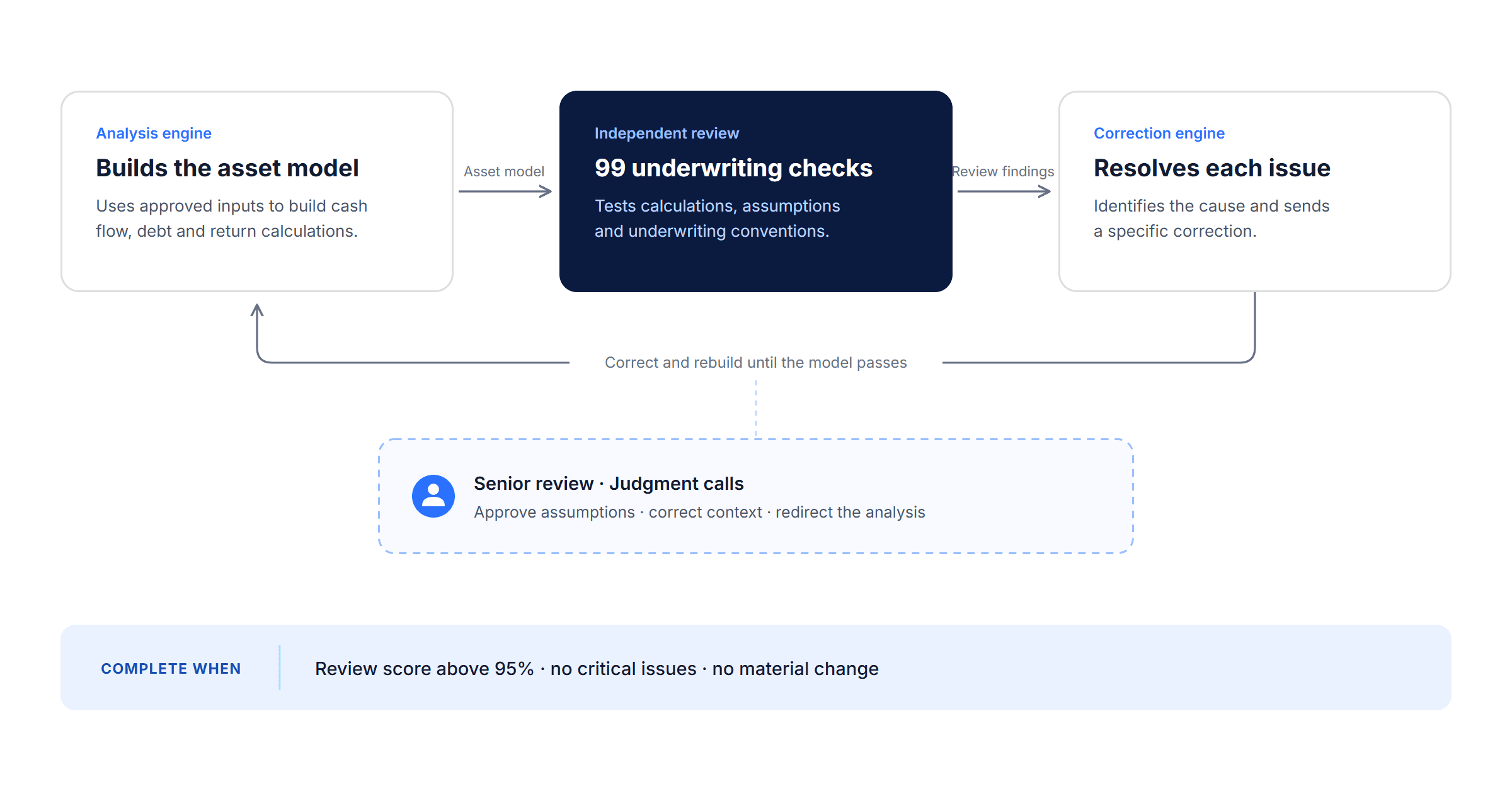
Exhibit 3 — The builder confirms that the model computes. The reviewer confirms that it is correct institutional analysis. A model can pass every test of the first while failing the second, which is why the two stay separate.
V
The evidence
The framework above has been tested on institutional underwriting problems and documented in published research, including the cases in which the system failed. Three results define what is possible today.
Reaching the review standard without manual correction
The test case was deliberately difficult: an opportunistic multifamily acquisition with phased renovation, bridge-to-permanent financing, a monthly interest reserve, an S-curve lease-up and a four-tier distribution waterfall across ten linked sheets. The first model scored 64% and contained thirteen critical issues, including an untracked bridge balance, an IRR formula linked to the wrong cash flow and reserves counted twice. The first correction cycle resolved eleven issues and lifted the score by 27 points. The second resolved the remainder. No person corrected the model during either cycle.
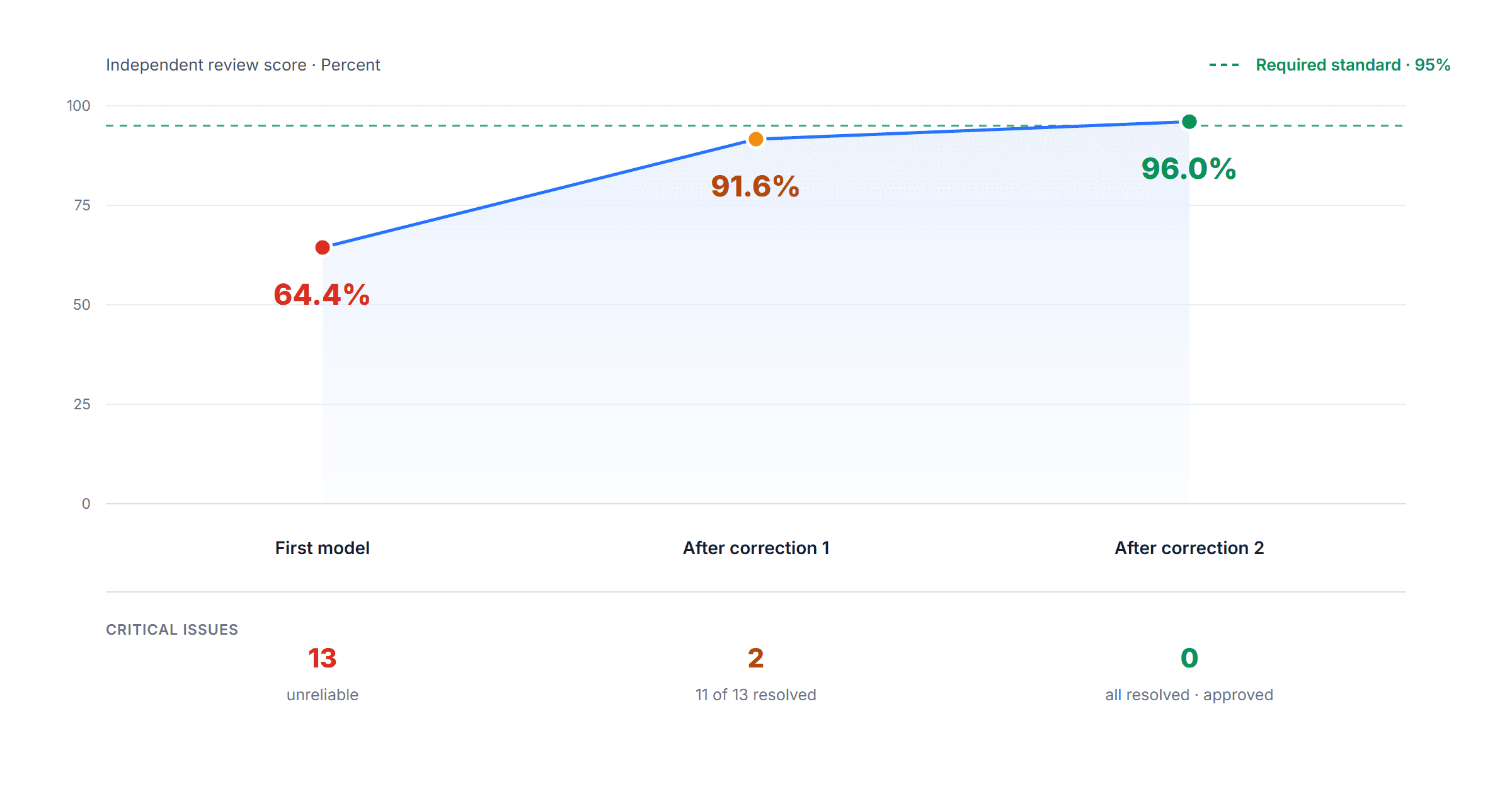
Exhibit 4 — Source: published research on self-correcting institutional financial models, 2026. The correction signal came entirely from the review framework; no human preferences or rankings entered the cycle.
Full screening completed in one session
In a separate published case, the system received 265 income-producing listings and three instructions: screen every asset, rank the candidates and underwrite the top ten. It proposed a rent-estimation method, a ranking framework based on yield, price basis and vintage, and a standard assumption set for human approval. It then completed the screening process through an institutional model. Work conventionally estimated at 30 to 50 analyst-hours was completed in one session, producing ten functioning underwriting files with live sensitivities. More importantly, the system explained why the cohort failed its hurdle rates: going-in yields sat below the cost of debt, so leverage reduced rather than improved returns. It also identified a modelling issue affecting one ranking and recommended an unlevered re-run to separate asset quality from capital structure.
The research also records the failures: two restarts when the system reached its working-memory limit, one model-integrity failure that required human correction and one contextual miss in which a renovation budget was applied to new construction. These cases define the current boundary of the technology: maintaining context across long assignments, preserving complex models and recognising when an asset requires an exception to the standard assumptions.
VI
The economic consequence
The results above matter to allocators because they change the economics of investment research.
Income-producing real estate is priced inefficiently relative to other asset classes for a structural reason: each asset is a unique bundle of location, condition, configuration, vintage, and operating cost environment, and pricing any single asset requires assembling a bespoke assumption set before a return calculation is possible. The assumptions are the work; the mathematics is mechanical. When assumption-setting costs hours per asset, the rational investor screens narrowly, applying rough filters to a large opportunity set and reserving rigorous price discovery for the five to ten assets that survive them. The remaining assets receive no rigorous pricing from anyone. That is not a failure of diligence. It is the correct response to the research cost structure, and it is the reason heterogeneous asset markets clear slowly and price imperfectly.
When AI-supported systems reduce research cost per asset by an order of magnitude, three consequences follow.
The screening universe expands. A team that could rigorously evaluate one market per quarter can evaluate several with the same headcount and at greater depth. When underwriting the 200th asset costs little more than underwriting the 10th, the long tail of the opportunity set becomes visible.
Price discovery accelerates and spreads compress. Heterogeneous assets resist efficient pricing because research cost creates information asymmetry between the few buyers who did the work and the many who could not afford to. As more buyers evaluate more assets at higher rigour, pricing converges toward fundamental value faster. It is the same mechanism by which falling research costs compressed spreads in less liquid corners of public markets.
Human judgment relocates to the layer where it is scarce. The binding constraint on an investment team stops being how many deals can be underwritten and becomes how good the assumptions are. Practitioner expertise concentrates at the input layer (validating rent structures against local knowledge, adjusting expense assumptions for conditions the data cannot see, overriding defaults for atypical assets) and at the judgment layer, where the three classified decision types operate. The computation layer, where most analyst hours currently go, is no longer where careers are made.
This chain also supplies the answer to the fee-compression problem that every institutional manager currently faces. Management fees are under structural pressure, and headcount growth cannot answer it: adding analysts at the old research cost structure widens the gap between revenue and cost rather than closing it. Operating leverage, producing more institutional-grade analysis per person at a fraction of the historical cost and time, is the only durable response, and the architecture in Section IV is what operating leverage is made of.
VII
Why this shift is the largest of the three
The migration to the spreadsheet changed how fast the industry could calculate. The migration to systems of record changed how reliably it could store information. The current migration changes which analytical work requires a person at all. That is a different kind of shift because it changes the boundary between machine work and human judgment, rather than simply making an existing task faster.
It is also why the shift will not remain limited to a few early adopters. When the cost and time of producing institutional-grade analysis falls by an order of magnitude, competitors cannot ignore the advantage. A firm that screens several times the opportunity set at equal rigour, brings models to review standard in hours rather than weeks and reserves senior judgment for assumptions rather than arithmetic is operating with a different cost and decision structure. Over a decade, that difference compounds. Institutional capital moved onto spreadsheets and then into systems of record because each became the minimum standard for operating well. Verified AI-supported analysis is likely to follow the same path.
The open questions are questions of sequence, not direction. Which firms build the verification architecture early, while it is still a differentiator, and which adopt it later, as the cost of not having it becomes visible in every competitive process they lose.
For allocators evaluating where to begin, the starting point is smaller than the thesis suggests. It is not a data science team, a platform build or a multi-year transformation programme. It is a single question, asked of the next deal that reaches the committee: can every material number in this memo be traced to an independent source, and if it cannot, what would it take to make that true? Pursued seriously, that question contains the entire transition in miniature. The supporting data, assumption libraries and review discipline can build from there. The only closed position is the assumption that today’s process will remain competitive on its own.
About Smart Bricks
Publisher
Smart Bricks is an AI lab for institutional real estate, serving acquisition and asset management teams.
Smart Bricks builds AI-supported investment workflows for institutional investors. Its systems bring together thousands of public and proprietary sources, including transactions, lease records, regulated cost benchmarks and the firm’s own screening data, to shorten the analytical cycle without compromising traceability or rigour. The controls described in this note form part of that operating model. Smart Bricks publishes recurring research for institutional investors and investment managers.
Platform
AI-supported acquisition and asset management workflows, at pipeline scale
Data
Thousands of public and proprietary sources: registered transactions, lease records, regulated benchmarks
Clients
Family offices · PE fund managers · REITs · Institutional private capital
Discuss this note with our team
This research is published for institutional and professional counterparties in real assets globally. If the framework here bears on a mandate, a process question, or an acquisition you are evaluating, we would welcome a private discussion.
© 2026 Smart Bricks. For informational purposes to institutional and professional counterparties only. Not investment advice. AUM figure: industry aggregate estimates. Findings in Sections IV–V summarise recently published research on AI-supported underwriting and financial model review; figures are as reported in that literature. Pipeline-hour benchmarks and adoption statistics reflect published industry surveys.